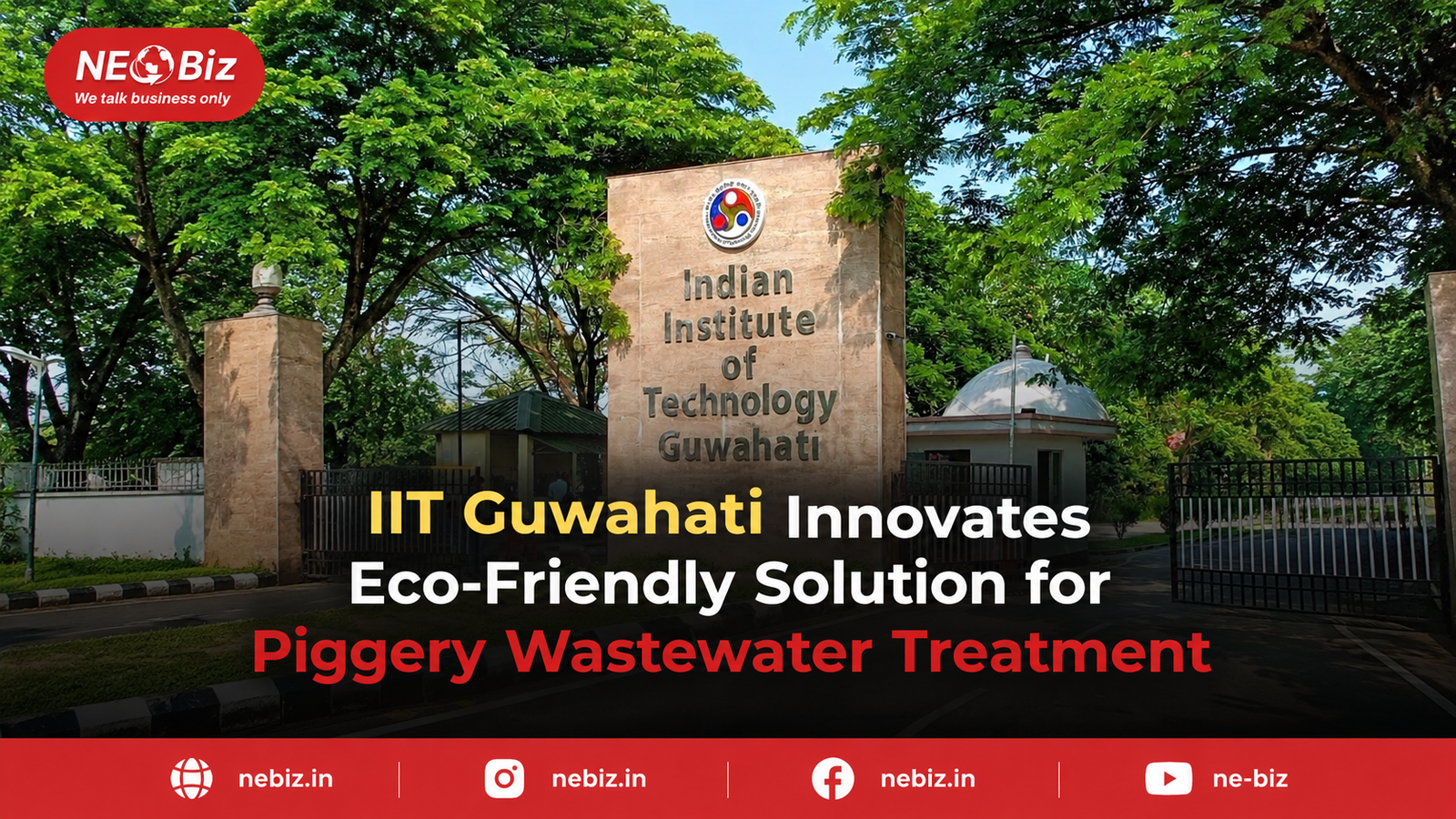
Researchers at the Indian Institute of Technology Guwahati (IIT Guwahati) have developed a nature-based technology aimed at treating polluted wastewater generated by piggery operations. The innovation focuses on providing an environmentally sustainable approach to managing wastewater from livestock activities, addressing both pollution concerns and the need for more efficient waste-management solutions.
Piggery wastewater can contain significant levels of organic matter and nutrients, making untreated discharge a potential environmental concern. Conventional treatment systems can require considerable infrastructure, energy and operational costs. The nature-based approach developed by researchers at IIT Guwahati seeks to provide an alternative by using natural processes to reduce pollutants and improve the quality of wastewater before its disposal or potential reuse.
The development is particularly relevant to the livestock and agricultural sectors, where effective wastewater management is becoming increasingly important. As commercial and small-scale pig farming expands, producers need solutions that can manage waste efficiently without placing excessive financial or environmental pressure on their operations.
Nature-based treatment technologies can offer several potential advantages because they can make use of biological processes and naturally occurring systems to remove or reduce contaminants. Such approaches can potentially lower dependence on energy-intensive treatment infrastructure while supporting more sustainable farming practices.
For Assam and the wider Northeast, the innovation has particular relevance given the importance of livestock-based livelihoods in rural communities. Pig farming is an important economic activity for many households across the region, and improved waste-management technologies could help producers address environmental concerns while maintaining viable agricultural operations.
The IIT Guwahati research also highlights the role of academic institutions in developing solutions to practical challenges faced by local industries and communities. Technologies emerging from research institutions can potentially move beyond laboratories and find applications in agriculture, livestock management and environmental services if they are successfully scaled and adopted.
The development could also create opportunities for businesses working in environmental technology, wastewater management, sustainable agriculture and livestock infrastructure. If the technology proves commercially viable at different scales, it could potentially be adapted for use by individual farms, commercial piggeries and larger livestock-processing operations.
Another important aspect is the possibility of integrating wastewater treatment with broader resource-management practices. Properly treated wastewater and recovered nutrients can, depending on the treatment system and applicable standards, contribute to more efficient use of water and agricultural resources. This could support a circular approach in which waste is treated as a resource rather than simply being discharged.
The innovation comes at a time when sustainability and environmental management are becoming increasingly important considerations for businesses. Agricultural enterprises are facing greater pressure to manage their environmental footprint, conserve resources and adopt cleaner production practices. Technologies that can deliver these outcomes while remaining affordable and practical could therefore have significant long-term potential.
For Assam’s livestock sector, accessible wastewater-treatment solutions could help balance economic activity with environmental protection. Supporting farmers with appropriate technology and technical knowledge could also encourage more responsible livestock production and reduce the impact of untreated waste on surrounding land and water resources.
IIT Guwahati’s nature-based wastewater treatment innovation therefore represents more than a technological development. It demonstrates how research and innovation can address an industry-specific environmental challenge while potentially creating opportunities for more sustainable agricultural practices. The next step will be determining how effectively the technology can be scaled, commercialised and adapted to different piggery operations.
With growing attention on sustainable agriculture, green technologies and responsible waste management, innovations such as this could become increasingly relevant to businesses and policymakers seeking practical solutions for reducing pollution while supporting the growth of the livestock economy.