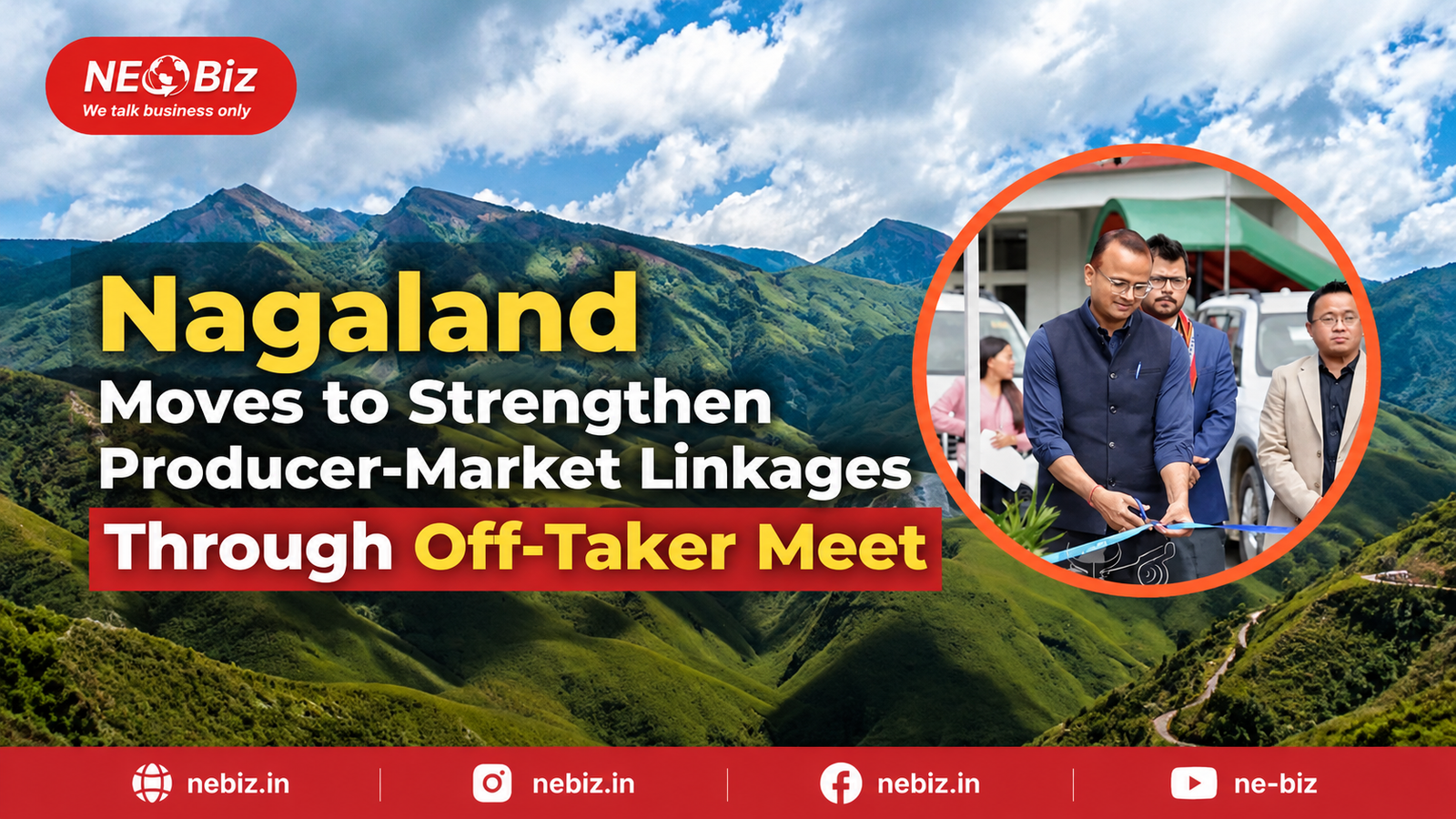
Nagaland is looking to strengthen the commercial ecosystem around its locally produced agricultural and forest-based products by improving connections between producers, buyers, technology providers and financial institutions. The initiative was highlighted at the one-day Off-Taker Meet 2026 organised by the ELEMENT Nagaland Project under the Society for Climate Resilient Agriculture in Nagaland (SoCRAN) in Kohima on October 7.
The meeting was held around the theme of connecting producers, markets and technology to create a stronger and more reliable market ecosystem. The discussions focused on a key challenge faced by many producers in the state: having marketable products is not enough unless there are dependable buyers, suitable pricing, consistent demand and the infrastructure needed to take products from production to market.
Nagaland has a diverse range of products with commercial potential, including coffee, honey, large cardamom, Naga chilli, black rice, millets, medicinal plants and wild fruits. These products are closely connected to the state's farms, forests and community-managed landscapes and can provide important sources of income when supported by efficient value chains.
A major focus of the initiative is to move beyond production and improve the different stages between the producer and the final customer. This includes aggregation of products, decentralised coffee processing, centralised honey processing, quality certification, branding, packaging and other forms of enterprise support.
For local producers, access to a larger market can be difficult without clear information about what buyers expect. Issues such as product grades, certification requirements, packaging standards, minimum volumes, pricing, delivery timelines and presentation can determine whether a product is commercially viable. The meet therefore sought to bring producers and market stakeholders together to address these requirements more directly.
At the same time, buyers need greater visibility of what Nagaland's producer groups can actually supply. Information about production volumes, quality and consistency is important for businesses when deciding whether to source products from a particular region. Building this confidence between producers and buyers could help create more regular commercial relationships rather than one-time transactions.
Certification and traceability were also identified as important areas. Several of Nagaland's products originate from community-managed and traditional landscapes, making practical systems for quality assurance and traceability important for reaching organised and potentially higher-value markets. Better certification can also help businesses establish stronger credibility when entering markets outside the state.
Financial institutions have a role to play alongside producers and buyers. Businesses and producer organisations may require working capital to purchase raw materials, process goods, improve packaging, maintain inventories and fulfil larger orders. Investment finance can also be necessary for processing equipment, storage facilities and other infrastructure required to scale operations.
The discussions therefore emphasised the need for greater coordination among government agencies, producer organisations, financial institutions, certification bodies and market participants. Such coordination could make it easier for local enterprises to access multiple forms of support without having to address each part of the value chain separately.
The initiative also has implications for value addition within Nagaland. Instead of selling agricultural and natural products primarily in raw or minimally processed forms, stronger processing and branding capabilities could allow businesses and producer groups to capture a larger share of the final value. Coffee processing, honey processing, packaging, branding and quality certification are examples of areas where additional economic activity can be created locally.
This approach could also open opportunities for small enterprises involved in logistics, food processing, packaging, storage, certification, branding and marketing. As producer groups become better connected with organised buyers, demand for these supporting services could increase alongside the growth of the primary products.
The Off-Taker Meet was organised as part of the ELEMENT Nagaland Project, which is working towards strengthening landscape-based value chains and creating sustainable economic opportunities. A presentation on the project and the objectives of the meet was delivered by ELEMENT Value Chain Expert Amarjit Lahkar. An awareness video titled “Project Awareness”, produced by Dreamz Unlimited, was also released during the programme.
Nagaland's effort reflects a broader shift towards treating agriculture, forest-based products and traditional production systems as components of organised business value chains. Improving market access, quality standards, processing capacity and financial support can help transform locally available resources into more commercially sustainable enterprises.
If these linkages are developed effectively, producers could gain access to more dependable markets while buyers could benefit from a clearer and more consistent supply base. For Nagaland, the larger objective is to build value chains that generate better returns for communities while creating opportunities for local enterprises and supporting sustainable management of the landscapes on which these livelihoods depend.